
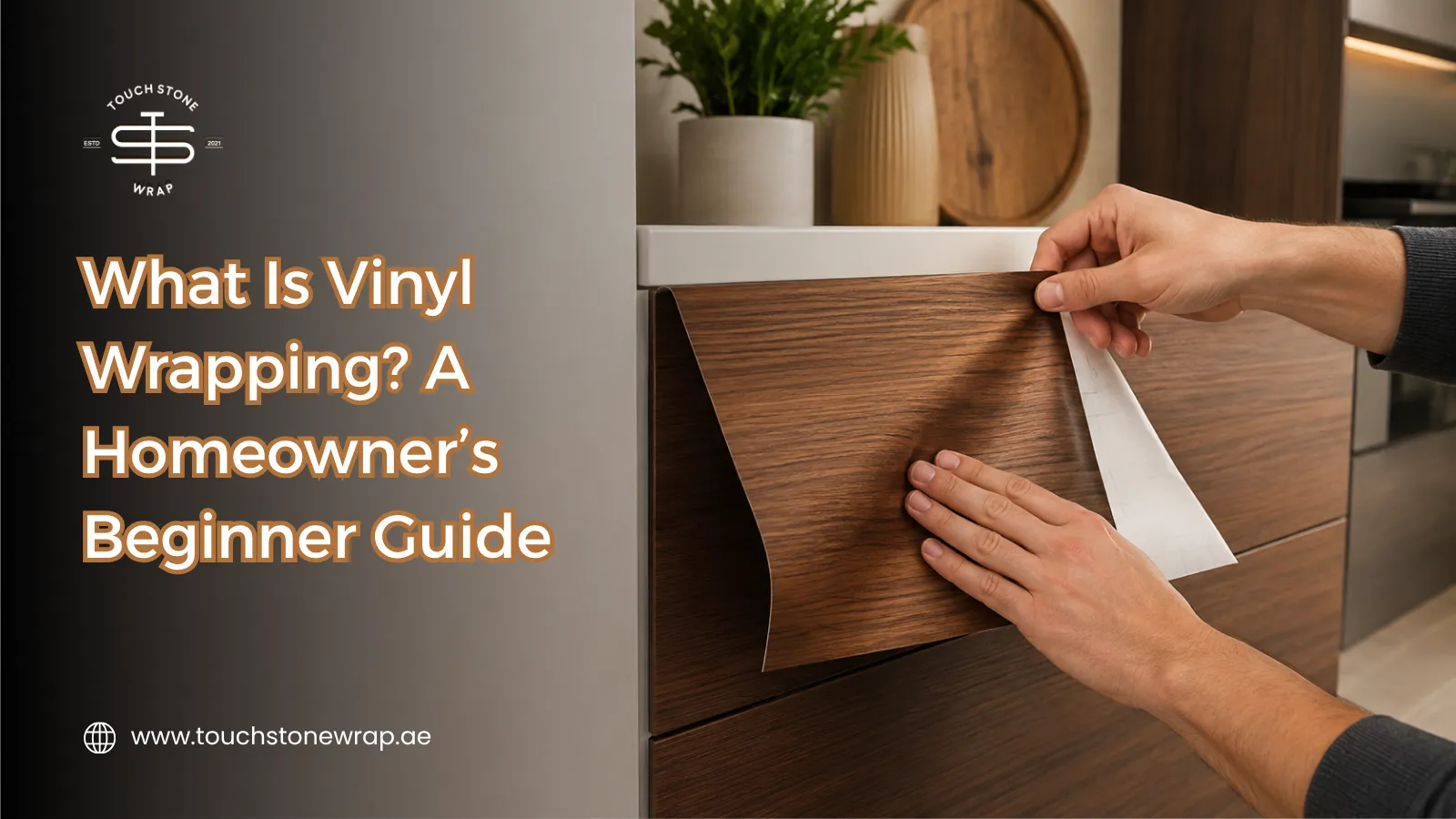
Vinyl wrapping is the process of applying a decorative, durable adhesive film over an existing surface to change its appearance without replacing the underlying material. If you’re wondering what is vinyl wrapping, think of it as a modern surface-renovation technique that can refresh kitchens, wardrobes, doors, furniture, walls, and other suitable interior elements. Instead of removing an existing finish, professional installers prepare the surface and apply a precision-cut vinyl film for a clean, updated look.
For homeowners considering a renovation in Dubai, this can provide a practical alternative to more disruptive replacement work.
What Is Vinyl Wrapping and How Does Vinyl Wrapping Work?
Vinyl wrapping uses a thin, flexible decorative film with an adhesive backing that bonds to a properly prepared surface. The film can replicate finishes such as wood, stone, marble, metal, concrete, or solid colours.
The basic process is straightforward, but professional results depend heavily on preparation and installation technique.
How vinyl wrapping works
- Surface assessment: The installer checks whether the existing material is smooth, stable, clean, and suitable for wrapping.
- Preparation: Grease, dust, residue, loose coatings, and imperfections are addressed before installation.
- Measurement and cutting: The film is accurately measured and cut for each panel, edge, door, or component.
- Application: The adhesive-backed material is carefully positioned and applied.
- Finishing: Edges, corners, seams, handles, and detailed areas are finished for a neat appearance.
- Inspection: The completed surface is checked for alignment, adhesion, bubbles, and edge quality.
Professional architectural films are designed for applications including doors, cabinets, furniture, walls, and other interior surfaces. For example, 3M’s DI-NOC range is specifically developed for refurbishing existing interior surfaces and is available in a wide variety of textures and patterns. (3M)
Which Surfaces Can You Use Vinyl Wrapping For?
Vinyl wrapping for homes is most useful when existing surfaces are structurally sound but visually outdated. The technique can transform many interior elements without removing the original substrate.
Common applications include:
- Vinyl wrapping kitchen cabinets and cupboard doors
- Wardrobe doors and panels
- Interior and entrance doors
- Tables, desks, shelving, and other furniture
- Wall panels and selected architectural surfaces
- Reception counters and commercial interiors
- Columns, partitions, and decorative panels
This is why interior vinyl wrapping is increasingly considered for targeted upgrades rather than treating every renovation as a demolition-and-replacement project.
For a closer look at how architectural films can transform existing interiors, see Architectural Vinyl Wrap Dubai: Transform Interiors Without Replacement.
When is a surface suitable?
The substrate generally needs to be stable and appropriately prepared. Deep damage, loose laminate, significant moisture problems, or heavily uneven surfaces may need correction before wrapping.
The quality of the existing surface matters because vinyl is a finish, not a structural repair system.
Why Consider Home Surface Wrapping Instead of Replacement?
Home surface wrapping can refresh an existing interior with less disruption than completely replacing otherwise usable surfaces. It is particularly useful when homeowners like the layout and condition of their cabinets, doors, or furniture but want a different colour, texture, or style.
A major advantage is design flexibility. Architectural films are available in finishes that imitate natural materials and contemporary decorative surfaces. 3M, for example, lists applications across walls, doors, cabinets, furniture, partitions, and other interior surfaces.
Key benefits of vinyl wrapping
| Benefit | What it means for homeowners |
| Visual transformation | Change outdated colours, patterns, or finishes |
| Less disruption | Avoid removing every existing cabinet or fixture |
| Design variety | Choose from wood, stone, metal, matte, gloss, and other effects |
| Reuse | Upgrade suitable existing surfaces rather than automatically replacing them |
| Easy maintenance | Many architectural films are designed to be cleaned and maintained easily |
For homeowners comparing vinyl wrapping vs renovation, the right choice depends on the condition of the existing substrate, the desired finish, the scope of the project, and the expected longevity.
It is not a universal substitute for structural renovation. If cabinets are damaged, warped, or poorly constructed, replacement may make more sense. But when the underlying surface is suitable, wrapping can be a compelling interior renovation alternative.
How Long Does Vinyl Wrapping Last in Dubai?
The lifespan of a wrap depends on the film specification, installation quality, surface preparation, location, cleaning routine, and exposure to heat or sunlight. Interior applications generally experience different conditions from exterior applications.
For Dubai homeowners, material selection is especially important because local environmental conditions can be demanding. Manufacturer technical data, rather than a generic lifespan claim, should be used when assessing a specific film and application. 3M’s technical documentation, for example, distinguishes performance by climate zone and exposure type. (3M Multimedia)
You can also explore How Long Does Vinyl Wrapping Last in UAE Climates? for more information about climate considerations.
What affects durability?
- Quality and specification of the vinyl film
- Proper substrate preparation
- Installer experience
- Heat and direct sunlight exposure
- Frequency and type of cleaning
- Amount of daily wear
- Quality of edge and corner finishing
For high-traffic areas, specialist abrasion-resistant architectural films are also available. 3M states that its abrasion-resistant DI-NOC products are designed to reduce visible scratching in demanding interior applications. (3M)
Is Vinyl Wrapping Good for Kitchens, Furniture, Doors and Wardrobes?
Yes, vinyl wrap for furniture, kitchens, doors, and wardrobes can be a practical way to update interiors when the underlying surfaces are appropriate for application.
Kitchen wrapping is particularly popular because cabinet doors and panels can have a major visual impact on the entire room. Similarly, wardrobe wrapping can modernise bedrooms without replacing complete storage systems.
Popular applications
- Kitchen wrapping: cabinet doors, panels, islands, and selected surfaces
- Furniture wrapping: tables, cabinets, desks, shelving, and decorative pieces
- Wardrobe wrapping: wardrobe doors and external panels
- Door wrapping: interior doors and suitable door surfaces
The biggest advantage is that homeowners can change the visual character of an existing item without necessarily changing its layout or function.
However, not every surface should automatically be wrapped. A professional assessment can identify unsuitable materials, damaged areas, moisture issues, or surfaces that require preparation first.
Check this out: Kitchen Vinyl Wrapping Dubai
Vinyl Wrapping vs Traditional Renovation: Which Is Better?
Vinyl wrapping is generally better suited to cosmetic and finish-level upgrades, while traditional renovation is more appropriate when the structure, layout, plumbing, electrical systems, or substrate itself needs major changes.
Consider the difference:
- Choose wrapping when the existing item is usable but looks dated.
- Consider replacement when the underlying structure is damaged.
- Choose traditional renovation when you need layout or construction changes.
- Consider wrapping when reducing demolition, waste, and disruption is a priority.
The concept of reusing existing surfaces is also reflected in architectural finishing systems designed to remodel and reuse existing assets while reducing downtime and material requirements. (3M)
For a homeowner, the smartest approach is not necessarily to choose one method for the entire property. A hybrid strategy can make sense—for example, wrapping suitable kitchen cabinetry while replacing only damaged components.
Common Questions About Vinyl Wrapping
What is vinyl wrapping used for?
Vinyl wrapping is used to change the appearance of suitable existing surfaces such as kitchen cabinets, wardrobes, doors, furniture, walls, and architectural panels without replacing the underlying substrate.
How does vinyl wrapping work?
A decorative adhesive film is carefully applied to a properly prepared surface. The installer measures, cuts, positions, adheres, and finishes the film around edges and detailed areas.
Is vinyl wrapping cheaper than renovation?
It can be more economical for cosmetic upgrades because suitable existing surfaces can be reused rather than completely replaced. The actual cost depends on the surface, film, preparation, design, and project size.
Is vinyl wrapping suitable for Dubai homes?
Yes, vinyl wrapping Dubai projects can be suitable for many interior applications. However, film selection, installation quality, surface preparation, and the property’s exposure conditions should be assessed before work begins.
Is Vinyl Wrapping Right for Your Home? Conclusion
So, what is vinyl wrapping? It is a surface transformation method that uses decorative adhesive film to give suitable existing interiors a new appearance without automatically replacing the underlying material. For homeowners, it can offer a practical way to approach kitchens, furniture, wardrobes, doors, and other interior surfaces.
If you’re considering a renovation alternative in Dubai, Touchstone Wrap Dubai can assess your existing surfaces and recommend suitable wrapping options based on your home’s condition, design goals, and application requirements.